
We all know the feeling. You cross the finish line, ride that massive wave of endorphins, and before the post-race banana is even peeled, you are scrolling on your phone looking for the next race to sign up for. In the running community, there is a pervasive and dangerous myth that “more is always better”, more miles, more races, more grind.
But as runners, we have to face reality: ambition without a biological blueprint is a recipe for disaster. Failing to properly plan your training blocks and cramming too many races into a short span doesn’t just lead to a plateau; it actively damages your cellular health, endocrine system, and long-term athletic potential.
Let’s step away from the runner’s high for a moment and look at exactly what the latest sports medicine research (including breakthrough 2024 and 2025 data) has to say about overtraining, racing too frequently, and the critical importance of periodization.
Overtraining Syndrome (OTS): A Multisystem Failure
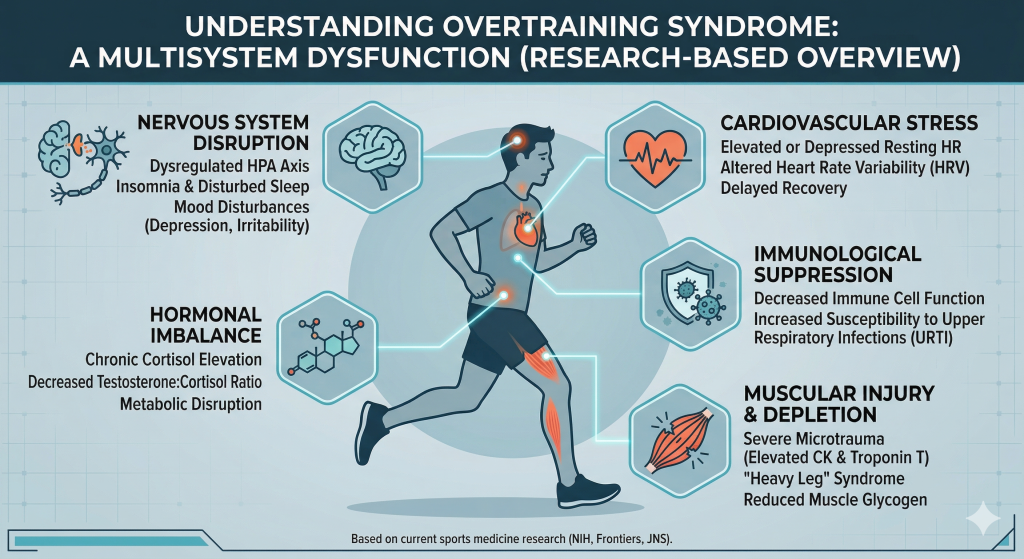
Pushing your body hard results in temporary fatigue, this is known as functional overreaching, and it’s necessary for growth. However, when you string together high-intensity efforts, long runs, and frequent races without adequate rest, you cross the line into Overtraining Syndrome (OTS).
OTS is not just “feeling tired.” A comprehensive 2024 review in Frontiers in Physiology defines it as a complex, multisystemic condition that persists despite extended rest.
The Clinical Reality: A July 2025 study published in BMJ Case Reports tracked three endurance athletes diagnosed with OTS. The researchers highlighted that because runners are used to pushing through pain, OTS is often misdiagnosed. Once you fall into true OTS, the mandated cessation from running can last for months.
Neurological and Endocrine Disruption: Chronic overtraining leads to a dysregulation of the autonomic nervous system. In endurance runners, this usually manifests as parasympathetic OTS. Symptoms include an unexplained drop in performance, persistent heavy muscles, prolonged fatigue, and an abnormally depressed resting heart rate (bradycardia).
Gut Health and Immune Suppression: Recent 2024 molecular research has linked OTS to significant alterations in the gut microbiome and chronic inflammation. Unrelenting endurance stress compromises the intestinal barrier, decreasing immune function and drastically increasing your susceptibility to upper respiratory infections.
The Hidden Cellular Cost of Racing Too Frequently
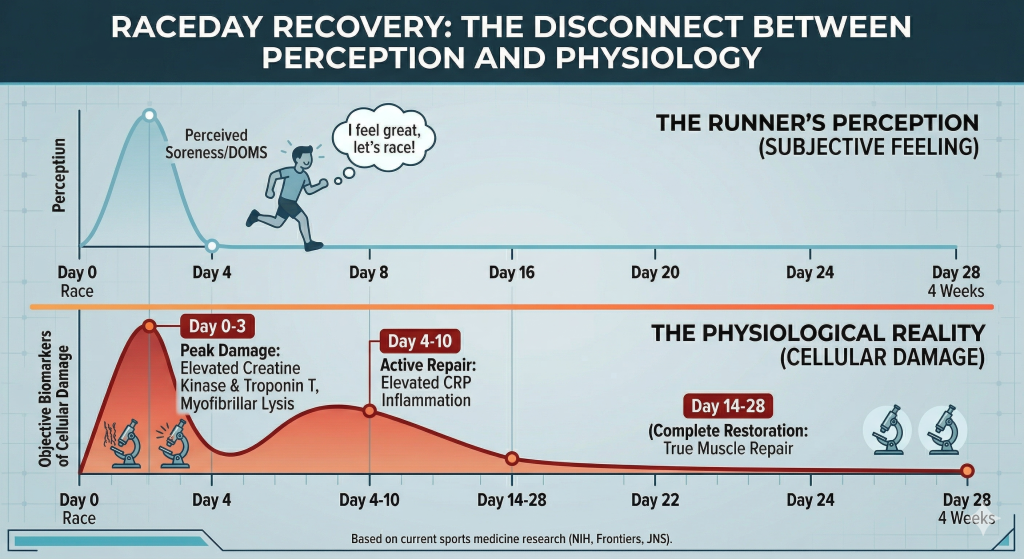
Many runners believe that if muscle soreness (DOMS) subsides after 3 to 4 days, they are fully recovered and ready to race again. The science definitively proves otherwise.
When you race a marathon or half-marathon, your body undergoes severe microscopic trauma.
The Timeline of True Recovery: While your perceived soreness might vanish in 72 hours, research demonstrates that true cellular, mitochondrial, and myofibrillar repair takes 3 to 4 weeks. Racing again within this window means you are forcing biologically damaged, energy-depleted cells to perform maximal efforts. Chronically doing this can cause your muscle tissue to repair itself with rigid fibrotic scar tissue instead of elastic muscle fibers.
Biomarkers of Organ Stress: A November 2025 study in the Journal of Applied Physiology tracking runners at the Boston Marathon found that markers for acute kidney injury and intestinal barrier injury remain substantially elevated well after the race.
Muscle Damage: Metabolic recovery studies show that markers of severe muscle damage, such as Creatine Kinase (CK) and Troponin T, remain highly perturbed for up to 144 hours (6 days) post-race. Muscle biopsies reveal focal fiber injury, including myofibrillar lysis (the breakdown of muscle fibers).
The Antidote: Periodization and Supercompensation
So, how do elite athletes continue to get faster without destroying their bodies? The answer is Periodization, the systematic planning of athletic training.
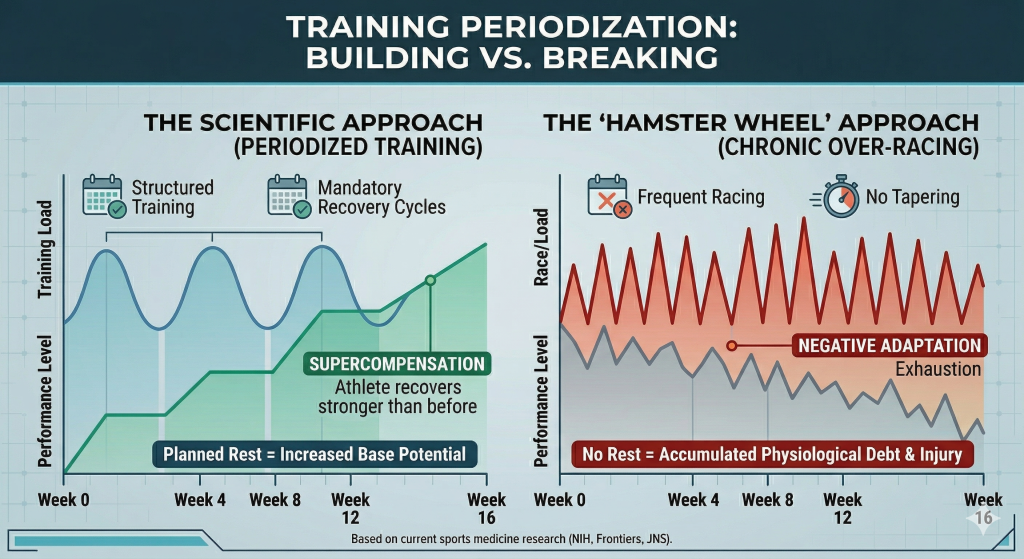
Periodization is rooted in the General Adaptation Syndrome model. It involves applying a specific, measured stressor to the body (the Alarm phase), followed by mandatory, strategic rest. During this rest, the body doesn’t just return to baseline; it repairs itself to be stronger than before. This physiological phenomenon is called Supercompensation.
Respecting the Off-Season: Proper periodization dictates that athletes should only peak for 1 to 3 “A-goal” races per year. Squeezing in high-intensity races every other weekend completely short-circuits the supercompensation phase, trapping the runner in a perpetual state of breakdown and exhaustion.
The Proof is in the PRs: A massive September 2025 study analyzed training data from Boston Marathon runners. They found that runners who had high training volumes 4 to 12 months out, but purposefully reduced their training frequency and volume in the 4 months leading up to the race (a proper periodized taper), achieved significantly faster finish times than those who tried to grind all the way to race day.
The Bottom Line
Your body is an incredibly adaptive machine, but it operates on strict biological timelines. Racing multiple times in a short span and ignoring structured training plans isn’t a badge of honor, it is a physiological debt that your body will eventually collect.
Train hard, but plan smarter. Respect the rest day, space out your goal races, and let the latest science dictate your recovery. Your future PBs depend on it.
References
- Weakley, J., et al. (September 2024). Beyond physical exhaustion: Understanding overtraining syndrome through the lens of molecular mechanisms and clinical manifestation. Discusses the multisystemic nature of OTS, gut microbiome alterations, and chronic inflammation.
- BMJ Case Reports. (July 2025). Overtraining Syndrome (OTS) in Three Endurance Athletes and Roads to Recovery. Outlines the clinical diagnosis, prolonged recovery periods, and multisystem dysfunction in professional and recreational runners.
- Journal of Applied Physiology. (November 2025). Biomarkers of organ stress and injury following the Boston Marathon. Highlights the delayed recovery of acute kidney and intestinal barrier injury markers post-marathon.
- Frontiers in Sports and Active Living. (September 2025). Training Volume and Training Frequency Changes Associated with Boston Marathon Race Performance. Demonstrates that periodized tapering (reducing load in the 4 months pre-race) correlates directly with faster marathon performance.
- Botha, M., et al. (2023). The metabolic recovery of marathon runners: an untargeted 1H-NMR metabolomics perspective. Highlights the delayed recovery of Creatine Kinase, Troponin T, and overall metabolic perturbations lasting well beyond perceived muscle recovery (up to 3-4 weeks).
Leave a Reply